The diode is one of the basic non-linear circuit components which conducts the current in only one direction. In operation, it is analogous to a mechanical check valve that allows the flow of fluid in one direction and blocks the flow in another direction. Similarly, diode also allows the flow of electron in only one direction, known as the forward direction. This unidirectional behavior is also known as rectification and is used to convert alternate current(AC) to direct current(DC). It would not be wrong to call this basic element as the flag bearer of the electronic edge.

Earlier diodes were thermionic diodes or vacuum diodes.which were bulky and required a heating element to operate. Before 1919, these were known as rectifiers and the effect was known as Edison effect. First engineering use of diode (other than scientific experiment) was for precision radio detection, nearly 20 years after the discovery at Marconi Company. Most commonly used diode today is the crystalline semiconductor p-n junction. The first semiconductor diodes developed around 1906, were made of mineral crystals such as galena. But today use of silicon, selenium, and germanium are more common. Current day technology also induces impurity in mineral crystals very precisely to control the properties of the current flow. Diodes are extensively used as rectifiers, signal limiters, voltage regulators, switches, signal modulators, signal mixers, signal demodulators, photo-detector, Ionizing radiation detectors, current steering, and oscillators. These are only a few application to be named, but its application is not limited only to these.

A diode can be characterized based on the method it is made or its intended application. The symbol for the different type of diode has only minor differences, but every symbol has a triangle pointing towards the forward direction, i.e. in the direction of conventional current flow.
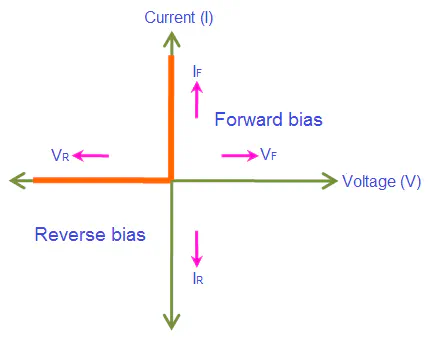
Real diodes are somewhat different than the ideal diode due to physical limitations of the device. A real diode requires a voltage to be maintained in the forward direction for current to flow. i.e. When the cathode is at a negative potential then the anode and forward break-over voltage is maintained, then current flows through the diode. The forward break-over voltage is approximately 0.6 Volt for silicon devices, 0.3 Volt for germanium devices, and 1 Volt for selenium devices. If the cathode is at a higher potential or anode to cathode potential difference is less than the forward break-over voltage only small leakage current will flow which can be neglected in most of the cases. This general rule doesn’t hold if the cathode voltage is positive relative to the anode voltage by enough amount. This reverse potential causes the junction to break and current flow to establish in reverse direction. Based on the diode type this breakdown voltage can be classified as Zener breakdown or Avalanche breakdown. Also, the breakdown voltage varies based on material and process of manufacturing.

Diodes can be classified by their physical construction, operating principles, or intended applications. Below, we organize them by use case to help you quickly find the right device for your design challenge.
Foundation: Start Here
Before exploring specialized diode types, understanding the underlying physics provides the foundation for all rectifying devices:
- PN Junction Physics and Mathematics - Complete mathematical treatment: Shockley equation derivation, depletion theory, carrier transport, breakdown mechanisms, temperature dependencies, and AC small-signal models—the theoretical backbone for all semiconductor diodes
Recommended for: Engineers designing diodes from first principles, students seeking rigorous understanding, anyone wanting to go beyond datasheet parameters to predict device behavior from material properties and geometry.
Optical (Photonic) Diodes
Emitters (Electrical → Light)
- Light-Emitting Diodes (LEDs) - Convert electrical current to visible or infrared light through radiative recombination
- Laser Diodes - Coherent, monochromatic light generation for fiber optics, barcode scanners, and optical storage
- Superluminescent LEDs (SLEDs) - Hybrid between LED and laser; broader spectrum than laser, narrower than LED; used in OCT medical imaging
Detectors (Light → Electrical)
- Photodiodes - Convert photons to electrical current; used in cameras, optical receivers, and sensors
- PIN Photodiodes - High-speed photodetectors for fiber optic communications (40+ Gbps)
- Avalanche Photodiodes (APD) - Internal gain through impact ionization; ultra-sensitive detection
- Single-Photon Avalanche Diodes (SPAD) - Quantum-level sensitivity for LIDAR, quantum cryptography, and single-photon timing
Voltage Regulation & Protection
Regulation
- Zener Diodes - Precision voltage reference and regulation (2.4V–200V); operates in reverse breakdown
- Stabistors (Forward Reference Diodes) - Voltage regulation using forward bias instead of breakdown; low-noise alternative to Zener
Protection
- Avalanche Diodes - High-voltage clamping and surge protection through controlled avalanche breakdown
- Transient Voltage Suppression (TVS) Diodes - Fast-acting protection against ESD, lightning, and inductive spikes; sub-nanosecond response
High-Frequency & RF Applications
Switching, Mixing & Detection
- Schottky Diodes - Metal-semiconductor junction with ultra-low forward voltage (0.2–0.45V) and zero reverse recovery time
- PIN Diodes - Wide intrinsic layer for RF switching, attenuators, and phase shifters (DC–100 GHz)
- Backward Diodes - Opposite of tunnel diode characteristic; excellent for low-voltage detection (mV range) and zero-bias mixing
- Snap-off (Step Recovery) Diodes - Abrupt reverse recovery for frequency multiplication and pulse generation; harmonic generation
- Point-Contact Diodes - Millimeter-wave detection and mixing; whisker-on-semiconductor construction
Frequency Control & Tuning
- Varactor (Varicap) Diodes - Voltage-controlled capacitance for VCOs, PLLs, and electronic tuning
Microwave Generation (Negative Resistance)
- Tunnel (Esaki) Diodes - Quantum tunneling creates negative resistance; ultra-fast switching (picoseconds), microwave oscillators
- Gunn Diodes - Transferred-electron effect generates microwave oscillations (1–100 GHz); radar and Doppler applications
- IMPATT Diodes - Impact ionization avalanche transit-time negative resistance for high-power microwave generation (>10W CW); includes TRAPATT and BARITT variants
Power & Current Management
Regulation
- Constant Current Diodes (Current-Limiting Diodes) - Self-regulating current source using JFET or bipolar structure
Power Switching
- Shockley Diodes (Four-Layer Diodes) - PNPN structure with breakover voltage; bistable switching device, triggers into latching conduction
- Super Barrier Rectifiers - Advanced Schottky structure with guard ring for lower leakage; bridges gap between Schottky and PN
- Gold-Doped Diodes - Lifetime killer doping for fast switching in legacy power circuits
Thermal
- Thermal Diodes - Temperature sensing using forward voltage-temperature coefficient (~-2 mV/°C)
- Peltier Diodes - Thermoelectric cooling through Peltier effect; solid-state heat pumps for laser stabilization and portable coolers
Legacy & Specialized
Historical Devices
- Cat’s Whisker (Crystal Diodes) - Point-contact metal-semiconductor junction; the original radio detector (1894–1940s)
- Vacuum Diodes (Thermionic) - Historical electron tubes; predecessor to semiconductor diodes
Environmental & Exotic
- Cryogenic Diodes - Operated at liquid nitrogen (77K) or liquid helium (4K) temperatures; ultra-low noise for astrophysics and quantum computing
Understanding by Physical Principles
While the above categorization focuses on applications, diodes can also be understood through their underlying physics. For the complete mathematical foundation including Poisson-continuity equations, Shockley derivation, and depletion theory, see PN Junction Physics and Mathematics.
Quantum Effects:
- Tunneling: Tunnel (Esaki) diodes (negative resistance), Backward diodes (low-voltage detection), Schottky diodes (metal-semiconductor barrier)
- Photonic Emission/Absorption: LEDs (spontaneous emission), Laser diodes (stimulated emission), SLEDs (amplified spontaneous emission), Photodiodes
Avalanche & Impact Ionization:
- Avalanche diodes, Zener diodes (>5V), TVS diodes (fast-clamping protection), SPADs (Geiger mode), IMPATT diodes (microwave generation via transit-time)
Multi-Layer Structures:
- PNPN Devices: Shockley diodes (four-layer bistable switching)
- Heterojunctions: Laser diodes (carrier/photon confinement), LEDs (bandgap engineering)
Junction Engineering:
- Intrinsic Layer: PIN diodes (wide depletion for speed and low capacitance)
- Doping Profile: Varactor diodes (hyperabrupt junctions for wide tuning range), Step recovery diodes (abrupt snap-off for frequency multiplication)
- Metal-Semiconductor: Schottky diodes, Super Barrier rectifiers, Point-contact diodes, Cat’s whisker (historical)
Bulk Effects:
- Transferred Electron: Gunn diodes (velocity-field nonlinearity in GaAs/InP for microwave generation)
- Carrier Lifetime Control: Gold-doped diodes (lifetime killer doping for fast recombination)
Forward-Bias Regulation:
- Stabistors (voltage reference using forward drop, not breakdown; low noise)
JFET/Bipolar Current Regulation:
- Constant current diodes (JFET pinch-off or bipolar saturation for self-regulating current)
Thermoelectric Effects:
- Peltier diodes (Seebeck/Peltier effect for solid-state cooling and heating)
Temperature-Dependent Properties:
- Thermal diodes (forward voltage temperature coefficient ~−2 mV/°C for precision sensing)
Thermionic Emission:
- Vacuum diodes (historical; electron emission from heated cathode, pre-semiconductor technology)
Cryogenic Operation:
- Cryogenic diodes (operated at 4K–77K for ultra-low noise in quantum computing and astrophysics)
Majority Carrier Devices (Fast, no minority carrier storage):
- Schottky diodes, Backward diodes, PIN diodes (under reverse bias)
Practical Circuit Design
Beyond understanding individual diode types, successful circuit implementation requires mastering the gap between datasheet parameters and production-ready designs:
- Diode Circuit Design: Practical Considerations and Common Mistakes - Comprehensive guide to device selection, thermal management, protection circuits, PCB layout, common design mistakes, measurement techniques, and real-world troubleshooting—bridging theory and reliable designs
Essential for: All circuit designers implementing diodes in production systems. Covers selection criteria (decision trees for choosing the right diode type), thermal management (junction temperature calculations, heatsink sizing, parallel diode pitfalls), protection strategies (reverse polarity, ESD hierarchies, snubber circuits), PCB layout (minimizing parasitics, Kelvin connections, thermal vias), common mistakes (temperature effects, inrush current, series resistance oversight), and validation techniques with oscilloscope-based debugging.
Now that your current has a specific direction, it’s time to explore the specific articles to understand how each diode type leverages different aspects of semiconductor physics—geometric scaling, doping levels, material selection, and junction engineering—to achieve specialized performance. Whether you need precision voltage regulation, gigahertz switching, or quantum-level light detection, there’s a diode optimized for your application. And when you’re ready to move from theory to implementation, the practical design guide ensures your circuits function reliably across temperature, voltage, and time.

Avalanche Breakdown: When Diodes Harness the Power of the Cascade
Understanding avalanche breakdown in diodes—from the physics of impact ionization to applications in surge protection, … Continue reading