Before the billion-transistor chips in your pocket existed, the digital revolution lived inside a piece of rock. In the early 1900s, radio was a wilderness of sparks and raw physics. To extract a signal, you didn’t toggle a gate; you took a fine phosphor-bronze wire—a “Cat’s Whisker”—and delicately probed a hunk of Galena crystal until you hit a microscopic “sweet spot.” This wasn’t just a hobby; it was the birth of the point-contact Schottky diode. Long before Bell Labs, these primitive mineral junctions were the first to tame the electron, proving that solid-state matter could rectify the invisible.
We call these devices ‘Jurassic’ because, like fossils from the Mesozoic era, they represent a primitive epoch in electronics—the age before integrated circuits, when solid-state physics emerged from natural mineral crystals rather than fabricated silicon.
A Mineral Radio
A crystal detector was a study in minimalist mechanical engineering. At its core, it consisted of two primary elements: a small, irregular hunk of semiconducting mineral—most commonly Galena (lead sulfide)—and a springy, needle-thin metal wire known as the “Cat’s Whisker.” The crystal was typically held firmly in a brass cup or embedded in a low-melting-point alloy like Wood’s metal to ensure a solid electrical return path. Opposite the crystal sat the whisker, mounted on a precision-threaded arm or a ball-jointed lever that allowed the operator to probe the mineral’s surface with microscopic accuracy.
Operating this “Jurassic” diode was an exercise in extreme patience. Because only certain microscopic “sensitive spots” on the crystal’s face could actually process a signal, the listener had to manually scan the surface, delicately tapping and dragging the wire until a burst of static or a distant voice finally crackled through the high-impedance earphones. It was a volatile setup; a heavy footstep in the room or a nearby door slamming could jar the whisker just enough to lose the contact point, plunging the broadcast back into silence. This was hardware at its most temperamental—a bridge between the raw earth and the invisible air that required a surgeon’s touch to maintain.
The “People’s Radio”
Despite its temperamental nature, the crystal detector became wildly popular. The secret? It was cheap.
Galena wasn’t just accessible; it was essentially “dirt cheap.” As a naturally occurring mineral (lead sulfide), it was one of the most common ores on Earth.
The Price of Entry: While commercial sets existed, a “homebrew” detector could be made for pennies. By the 1920s, you could buy a “pea-sized” chunk of Galena in a small tin for a few cents.
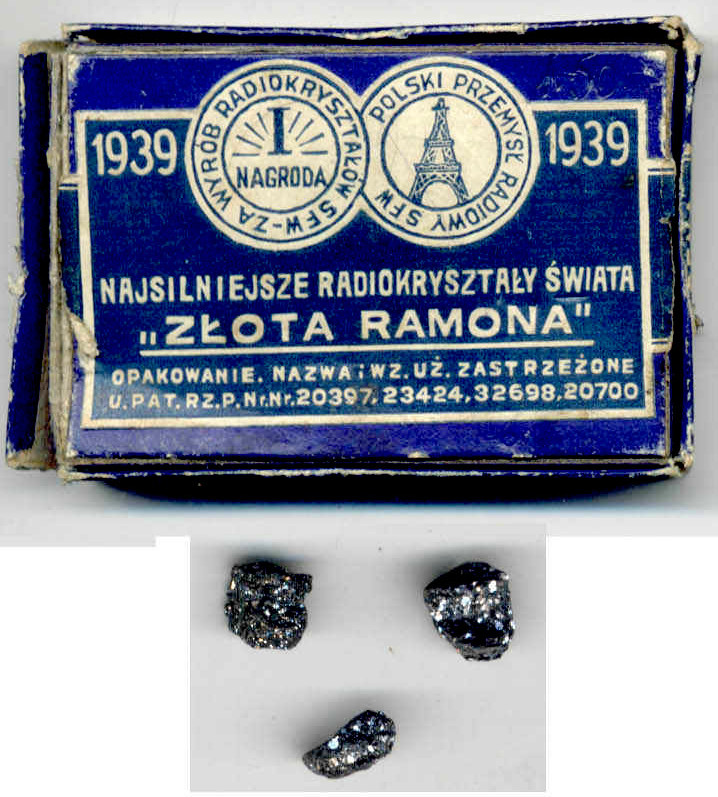
The DIY Explosion: Because it required no batteries and very few parts, it became the first viral “maker” project. Anyone with a spool of wire, a pencil lead (for a makeshift whisker), and a piece of rock could build a receiver. It was the ultimate “off-grid” technology, used by farmers in remote areas and later by soldiers in WWI trenches (the famous “foxhole radios”).
This accessibility democratized radio technology in a way that no previous invention had. While the telegraph required massive infrastructure and trained operators, crystal radio put the power of wireless communication directly into the hands of ordinary people. It was electronics for the masses—no power supply, no complex circuitry, just raw physics you could hold in your hand.
An Accidental Revolution
The invention of the crystal detector wasn’t a single “Eureka” moment, but a series of accidental observations by physicists who were often looking for something else. In 1874, Karl Ferdinand Braun noticed that certain crystals, like galena and copper pyrites, conducted electricity in only one direction—a phenomenon he called “asymmetric conduction.” At the time, the physics community had no framework for quantum mechanics or band theory; to them, Braun had simply found a “magic rock” that defied the standard laws of Ohm’s resistance.
Contemporary Alternatives: The Clunky Competition
Before Bose’s crystal detector, the world relied on the Coherer—a device that was arguably more “mechanical” than “electronic.”
The Coherer: A glass tube filled with metal filings. When a radio wave hit it, the filings would “cohere” (stick together) and become conductive.
The Reset Problem: The biggest drawback? Once the filings stuck together, they stayed that way. You had to physically tap the tube with a mechanical hammer (a “decoherer”) to reset it for the next bit of Morse code.
Bose’s Breakthrough: Bose’s galena detector was self-recovering. It didn’t need to be hit with a hammer to reset; it simply rectified the signal and was ready for the next wave instantly. This was the shift from “mechanical switching” to “solid-state physics.”
The “Invisible” Pioneer: Bose vs. Marconi
While the coherer was clunky and mechanical, one physicist was already thinking in terms of solid-state semiconductors.
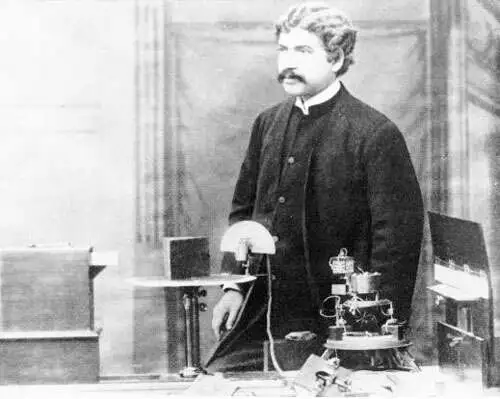
It took the brilliance of Jagadish Chandra Bose and Greenleaf Whittier Pickard to turn this quirk of physics into a functional radio component. While Guglielmo Marconi was capturing the world’s imagination with long-wave transatlantic signals, Jagadish Chandra Bose was working in a completely different regime—one that would eventually define modern telecommunications. In 1894, three years before Marconi’s first patent, Bose was demonstrating the wireless ignition of gunpowder and the ringing of bells through walls in Calcutta. Crucially, while Marconi was still using the clunky coherer, Bose invented a self-recovering galena crystal detector.
Bose’s 1901 patent for the “Detector for Electrical Disturbances” was the first to use a semiconductor junction to detect radio waves. While Marconi eventually won the Nobel Prize, his famous 1901 transatlantic reception actually relied on a “mercury-iron-carbon” detector—a design that many historians now believe was based on Bose’s own technical briefings. For a modern hardware engineer, Bose is the hero of the story; he wasn’t just sending “beeps” across the ocean; he was building the first millimeter-wave logic, operating at 60 GHz—a frequency range we only recently reclaimed for 5G and high-speed satellite links.
The Patent Scandal and the “Italian Navy” Mystery
The controversy over Bose vs. Marconi isn’t just about a lack of recognition—it’s a genuine historical “whodunit” involving a device called the “Italian Navy Coherer.”
The Hidden Source: For his famous 1901 transatlantic transmission, Marconi didn’t use his own filings coherer (it wasn’t sensitive enough). Instead, he used a “mercury-iron” detector. Historians (and the IEEE) have since found evidence that this design was actually invented by Bose and presented to the Royal Society in 1899.
The “Solari” Connection: It’s believed that a childhood friend of Marconi, Lieutenant Luigi Solari, obtained the design from Bose’s publications and handed it to Marconi, who then patented a “trivially modified” version.
The Nobel Snub: Marconi won the Nobel Prize in 1909. Bose, meanwhile, was largely ignored by the Western prize committees, partly due to the racial biases of the colonial era and his own refusal to aggressively commercialize or patent his early work. He famously said, “I am only interested in research, not in making money.”
Modern Vindication: It took nearly a century, but the IEEE eventually formally recognized Bose as the “Father of Radio Science,” noting that his 60 GHz work and his semiconductor junctions were decades ahead of their time.
The Accidental Schottky Diode
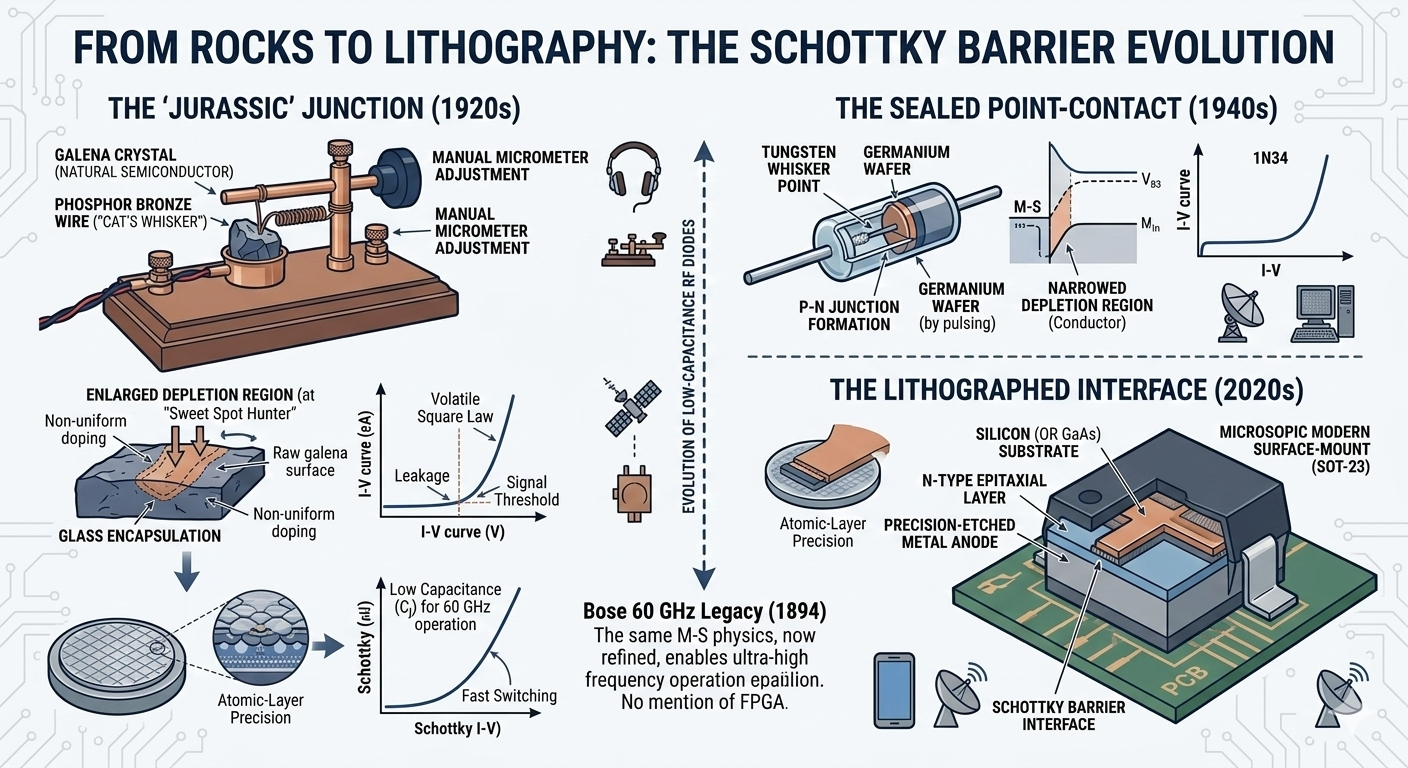
The historical controversy aside, the real miracle is what these early experimenters created without knowing it. In the “Jurassic” era of electronics, engineers weren’t trying to invent a new class of solid-state physics—they were just trying to hear a radio signal. Yet, by poking a rock with a wire, they created the world’s first Metal-Semiconductor (M-S) Junction. Today, we call this the Schottky Barrier, but for decades, it remained a functional mystery.
The physics boils down to a difference in Work Functions. Every material has a specific “cost” requirement (energy) to move an electron from its surface into a vacuum. Galena (lead sulfide) is a natural $n$-type semiconductor, and the phosphor-bronze wire is a conductor. When they touch, electrons migrate from the material with the lower work function (Galena) to the one with the higher work function (phosphor-bronze wire) to equalize the Fermi levels.
This migration creates a depletion region: a microscopic layer at the interface that is void of mobile charge carriers. This layer acts as an insulator in one direction and a conductor in the other.
Note: This article provides a historical overview of the Schottky barrier’s discovery. For a deep dive into the quantum mechanics, band theory, and modern fabrication techniques of Schottky junctions, see our companion article: Understanding Schottky Barrier Physics.
The “One-Way Valve” Analogy
Think of the junction as a mechanical check valve in a water pipe.
Forward Bias: When the radio’s AC signal pushes electrons toward the junction, the “pressure” shrinks the depletion region, opening the valve and letting current flow.
Reverse Bias: When the signal flips and tries to pull electrons back, the depletion region widens instantly, slamming the valve shut.
Because the “Cat’s Whisker” is a point contact—literally a microscopic tip, it possesses an incredibly low parasitic junction capacitance ($C_j$). This was the “lucky accident”. This low $C_j$ is the reason Bose could use these primitive minerals to rectify signals in the 60 GHz range over a century ago, at frequencies that would have been “shorted out” by the high internal capacitance of the vacuum tubes that eventually replaced them.
How the crystal radio was tuned by scanning
When radio hobbyists were hunting for a “sweet spot,” they were searching for a microscopic coordinate on the crystal where the doping profile was just right to create a thin enough depletion region. If they poked a spot with too many impurities, the barrier was too small (a “leaky” diode); if there were too few, the barrier was too wide, and even the strongest radio station couldn’t provide enough “pressure” to achieve Forward Bias.
From Rocks to Radar: The Legacy of the Point-Contact
The cat’s whisker might have remained a hobbyist’s curiosity, but war changed everything. The “Jurassic” cat’s whisker didn’t die out; it evolved. During World War II, the development of RADAR required mixers that could handle microwave frequencies. Vacuum tubes were too “clunky”—their high internal capacitance acted like a low-pass filter, killing any signal in the Gigahertz range. Engineers looked back at the work of Bose and Pickard, realizing that a point-contact crystal was the only thing fast enough to rectify a radar pulse.
This research led to the 1N21 and 1N34 germanium diodes—the first mass-produced, encapsulated descendants of the cat’s whisker. These weren’t “poked” by a hobbyist; they were factory-set and sealed, but the internal physics remained exactly the same: a microscopic metal point pressing against a semiconductor.
| Parameter | 1910s Galena | 1940s 1N34 | Modern Schottky |
|---|---|---|---|
| Forward Voltage | 0.3-0.6V | ~0.3V | 0.2-0.45V |
| Capacitance | <1pF | 0.5-1pF | 0.1-2pF |
| Max Frequency | 60+ GHz | 10 GHz | 100+ GHz |
| Reliability | Poor (vibration) | Good | Excellent |
Is it used in modern RF?
In the world of high-speed digital design and RF, the Schottky diode is a cornerstone. While you won’t find a hunk of Galena on your PCB, the Schottky Barrier Diode (SBD) is a critical component in:
- RF Mixing and Detection: Because Schottky diodes have nearly zero “reverse recovery time” (they don’t have to wait for minority carriers to recombine like standard P-N diodes), they are still used for high-frequency envelope detection and signal mixing up into the Terahertz range.
- I/O Protection: As an engineer, you see these every day. Schottky diodes are used as clamping diodes on I/O pins to protect the sensitive CMOS gates from overvoltage and ESD. Their low forward voltage ($V_f$) ensures they turn on and shunt the current to the rail before the internal silicon is damaged.
- Power Efficiency: In “Zero-Bias” RF detectors, modern Schottky diodes allow for harvesting energy from ambient radio waves—a direct descendant of the crystal radio’s “battery-less” operation.
The Full Circle
Today, as we push into 60 GHz (WiGig) and satellite-to-satellite quantum links, we are finally returning to the frequencies Jagadish Chandra Bose was exploring in 1894. We’ve traded the “sweet spot” on a rock for precision-lithographed Schottky junctions on Gallium Arsenide (GaAs), but the principle remains: a metal-semiconductor interface, a depletion region, and the magic of asymmetric conduction.
Refrences
- Bose, J. C. (1904). “Detector for Electrical Disturbances.” U.S. Patent 755,840A.
- Pickard, G. W. (1906). “Means for receiving intelligent communication by electric waves.” U.S. Patent 836,531.
- Emerson, D. T. (1997). “The Work of Jagadis Chandra Bose: 100 Years of MM-Wave Research.” IEEE Transactions on Microwave Theory and Techniques.
- Bondyopadhyay, P. K. (1998). “Sir J.C. Bose’s Diode Detector Received Marconi’s First Transatlantic Wireless Signal of December 1901 (The ‘Italian Navy Coherer’ Scandal Revisited).” Proceedings of the IEEE.
- The Silicon Engine (Computer History Museum). “1941: Semiconductor diode rectifiers serve in WW II.”
- “Crystal Fire: The Invention of the Transistor and the Birth of the Information Age” by Michael Riordan.
- “The (Pre-) History of the Integrated Circuit” by Thomas H. Lee (IEEE Solid-State Circuits Society).
- “Jagadish Chandra Bose: The Real Inventor of Marconi’s Wireless Receiver” (IETE Technical Review).